

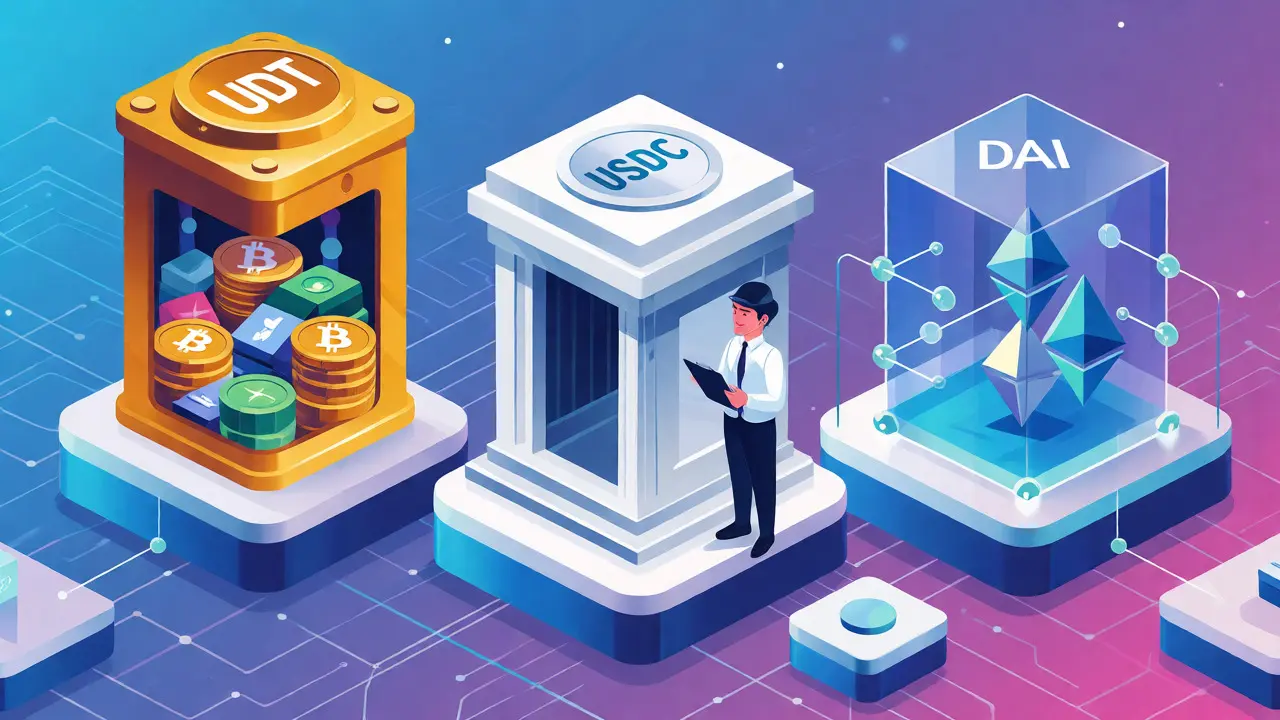
You’re staring at three dollar coins on your exchange screen. They all say $1.00. But one is backed by a company in El Salvador, another by a bank account in New York, and the third by smart contracts that could theoretically vanish if Ethereum goes dark. Which one do you actually hold?
Choosing between Tether (USDT), the world's largest stablecoin issued by Tether Limited, USD Coin (USDC), and a decentralized stablecoin managed by MakerDAO isn’t just about picking a ticker symbol. It’s about deciding how much risk you want to take with your money. Are you optimizing for speed? Regulatory safety? Or maximum yield in decentralized finance (DeFi)?
The Big Three: Market Share and Dominance
As of late 2025, these three tokens control over 87% of the entire stablecoin market. That’s a massive concentration of value. USDT remains the heavyweight champion with roughly 53% of the market, valued at around $86 billion. It’s the default currency for most exchanges, especially in Asia and emerging markets.
USDC has been gaining ground, holding about 30% of the market ($49 billion). It’s the darling of institutional investors and U.S.-based entities because it plays by the rules. Then there’s DAI, sitting at a modest but influential 4% ($6.5 billion). While smaller, DAI punches above its weight in the DeFi sector, where trustlessness matters more than convenience.
Why does this matter? Liquidity. If you’re day-trading Bitcoin against a stablecoin, you want the pair with the deepest order books. USDT wins here every time. Its daily trading volume hovers around $58 billion, nearly double that of USDC. If you’re trying to move $1 million without moving the price, USDT is usually your safest bet for pure execution speed.
How They Stay Pegged: The Trust Model
This is where things get interesting. All three claim to be worth $1 USD, but they achieve this through completely different mechanisms.
USDT is centralized. Tether Limited holds reserves-cash, Treasury bills, loans, and even some Bitcoin-to back each token. In Q1 2025, their reserves were split roughly 46% into U.S. Treasuries, 18% into secured loans, and 15% into corporate bonds. Critics have long questioned whether these assets are liquid enough to cover redemptions during a panic. However, Tether argues that their diversified portfolio generates yield, which funds infrastructure improvements.
USDC takes a stricter approach. Circle, the issuer, keeps 1:1 backing in cash and short-term U.S. Treasury securities held in regulated U.S. financial institutions. These accounts are segregated from Circle’s operating funds. Monthly attestations by Grant Thornton LLP provide transparency. This model appeals to anyone worried about counterparty risk. You know exactly where the money is, and it’s legally protected.
DAI flips the script entirely. It’s not backed by fiat reserves. Instead, users lock up other cryptocurrencies (like ETH or USDC) as collateral in MakerDAO smart contracts. To mint $1 of DAI, you might need to lock up $1.40 worth of ETH. This over-collateralization ensures that even if the price of ETH crashes, the system can still redeem DAI for its underlying value. It’s code-backed, not bank-backed.
Regulatory Risk and Censorship Resistance
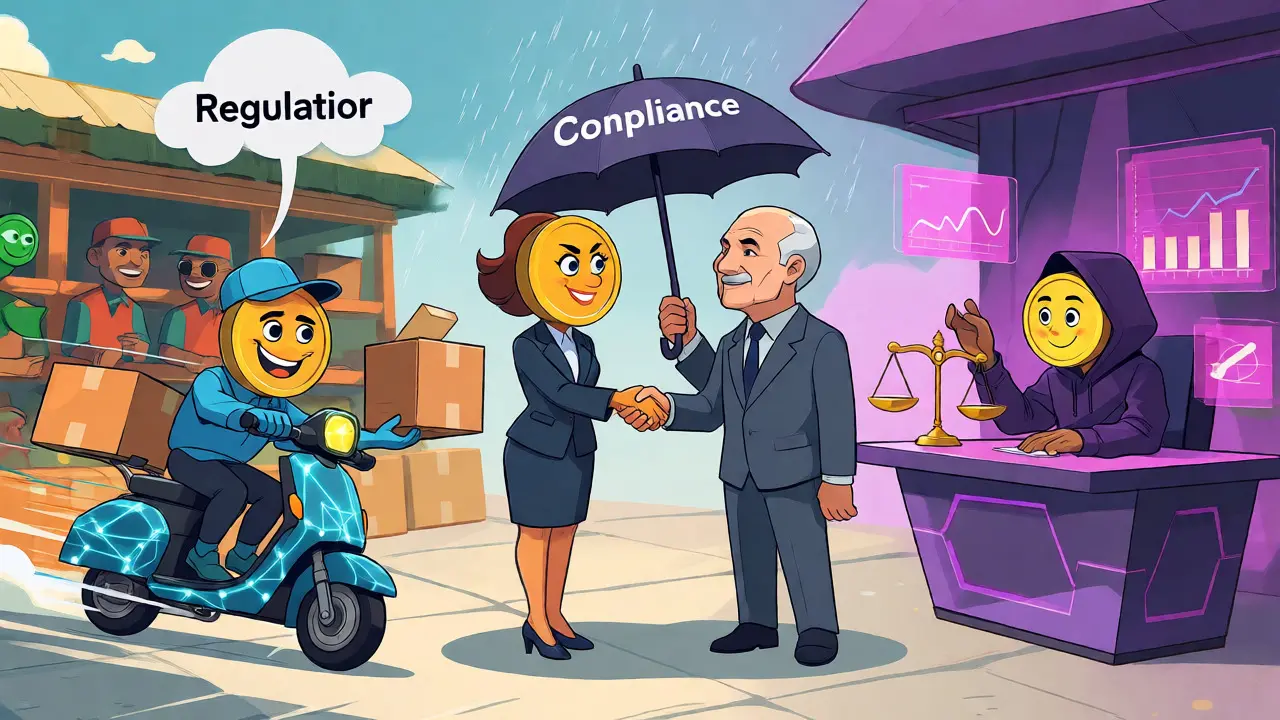
If you care about who can freeze your funds, pay attention. USDC is highly compliant. It adheres to OFAC sanctions lists, meaning Circle can freeze addresses linked to sanctioned entities. In 2024, nearly 99% of frozen USDC transactions were due to these compliance checks. For a business operating under strict U.S. regulations, this is a feature, not a bug. It passed the GENIUS Act requirements for 'Qualified Stablecoins,' making it safe for banks and traditional finance players.
USDT is less cooperative. While it also complies with some sanctions, its track record is messier. It faces ongoing scrutiny from the CFTC regarding reserve disclosures. In September 2025, the SEC took action against Tether for inadequate disclosure of reserve risks. If you’re looking for censorship resistance, USDT offers slightly more freedom than USDC, but it’s still far from perfect.
DAI is the most resistant to censorship. Since it runs on public smart contracts, no single entity can easily freeze your balance unless governance votes to upgrade the contract in a way that affects your specific vault. However, this comes with jurisdictional ambiguity. Regulators in the EU and elsewhere are still figuring out how to classify decentralized stablecoins like DAI under MiCA regulations.
Transaction Costs and Speed
Let’s talk about getting your money from point A to point B. This varies wildly depending on which blockchain you use.
USDT is versatile. It exists on over 15 blockchains. On Tron, transfers cost fractions of a cent ($0.0014) and settle in under two seconds. On Ethereum, it’s slower and pricier. Most retail users prefer Tron or Solana versions of USDT for cheap remittances.
USDC is primarily an Ethereum-based asset, though it expands to Solana and Avalanche. Sending USDC on Ethereum mainnet costs between $0.45 and $1.20 depending on network congestion. It’s reliable but not cheap for small transactions. Many businesses absorb this cost for the sake of regulatory certainty.
DAI lives almost exclusively on Ethereum. Expect gas fees similar to USDC, ranging from $0.85 to $2.10 per transaction. Because DAI is heavily used in complex DeFi interactions (like looping leverage), users often tolerate higher fees for the utility it provides.
| Feature | USDT (Tether) | USDC (Circle) | DAI (MakerDAO) |
|---|---|---|---|
| Market Share | ~53% | ~30% | ~4% |
| Backing Mechanism | Fiat & Crypto Reserves | Cash & U.S. Treasuries | Crypto Over-Collateralization |
| Avg. Tx Cost (Mainnet) | $0.001 - $0.50 | $0.45 - $1.20 | $0.85 - $2.10 |
| Transparency Rating | 6.2/10 | 9.1/10 | 8.7/10 |
| Best For | Liquidity & Trading | Institutions & Compliance | DeFi Yield & Decentralization |
Yield Opportunities in DeFi
If you’re holding stablecoins to earn interest, DAI often wins. Because it’s native to DeFi protocols, it integrates seamlessly with lending platforms like Aave and Curve. Users report average APYs of 4.72% across various protocols. USDC follows closely at 3.85%, largely because it’s also widely accepted in DeFi. USDT lags behind at 2.91%, partly because many high-yield DeFi strategies avoid it due to perceived centralization risks.
However, earning yield on DAI requires understanding liquidation risks. If you borrow DAI against ETH and the price of ETH drops sharply, you might get liquidated. During the March 2025 market swings, 1.7% of DAI positions faced liquidation triggers. USDC and USDT don’t carry this direct liquidation risk when simply held, though they can depeg temporarily.

Peg Stability: When Things Go Wrong
No stablecoin is perfectly stable. History shows us what happens when stress hits the system.
In March 2023, USDC briefly dropped to $0.88 because Silicon Valley Bank, where Circle held some reserves, collapsed. It recovered within 12 hours once Circle moved those funds. USDT dipped to $0.95 during the same period but bounced back faster.
DAI stayed pegged within 1.5% during that crisis. However, in May 2021, during an ETH crash, DAI spiked to $1.12 because people rushed to buy it as a safe haven, driving demand up while supply was constrained by liquidations.
These deviations remind us that "stable" doesn't mean "fixed." It means "highly correlated." Your choice should depend on your tolerance for short-term volatility versus long-term systemic risk.
Which One Should You Choose?
There is no single winner. It depends on your job-to-be-done.
- Choose USDT if: You are an active trader needing deep liquidity, you operate in emerging markets with limited banking infrastructure, or you prioritize low transaction fees via networks like Tron.
- Choose USDC if: You are a business handling cross-border payments, you require regulatory compliance for audits, or you want peace of mind knowing your dollars are backed by U.S. government debt.
- Choose DAI if: You are a DeFi power user seeking higher yields, you value decentralization and want to avoid reliance on a single company’s solvency, or you are comfortable managing collateral ratios.
Many sophisticated investors now use a hybrid approach. They keep USDT for quick trades, USDC for savings and business operations, and DAI for generating yield in decentralized pools. Diversifying across stablecoin models mitigates the risk of any single issuer failing.
Is USDT safer than USDC?
Generally, USDC is considered safer from a regulatory and transparency standpoint. Its reserves are fully backed by cash and U.S. Treasuries in regulated banks, with monthly attestations. USDT has a more complex reserve composition including loans and Bitcoin, leading to lower transparency ratings. However, USDT has survived multiple market crises, proving its resilience despite skepticism.
Can I convert USDT to USDC directly?
Yes, most major exchanges allow direct conversion between USDT and USDC. You can also swap them using decentralized exchanges (DEXs) like Uniswap or Curve. Be aware that swapping on-chain incurs gas fees, whereas trading on a centralized exchange usually involves only trading fees.
Why is DAI more expensive to transfer than USDT?
DAI operates primarily on the Ethereum blockchain, which has higher transaction (gas) fees compared to networks like Tron or Solana where USDT is commonly used. Additionally, DAI interactions often involve complex smart contract calls that consume more gas than simple token transfers.
What happens if MakerDAO fails?
If MakerDAO were to fail catastrophically, DAI holders would likely lose access to redemption mechanisms. However, the protocol has emergency shutdown features designed to auction off collateral to repay DAI holders. While not guaranteed, these mechanisms aim to minimize total loss even in extreme scenarios.
Are stablecoins taxable?
Tax laws vary by country. In the U.S., swapping one stablecoin for another (e.g., USDT to USDC) may be treated as a taxable event if there is a gain or loss relative to your basis. Holding stablecoins generally does not trigger tax until you dispose of them, but consult a local tax professional for specific advice.