


Imagine swapping tokens to buy a digital collectible from your favorite anime series or securing tickets to a concert, all while paying fractions of a cent in gas fees. That is the promise of Uniswap v3 on Soneium, an Ethereum Layer 2 blockchain developed by Sony Block Solutions Labs designed for entertainment-focused Web3 applications. But does this new integration actually deliver on that hype, or is it just another fragmented liquidity pool waiting to happen?
As we move through mid-2026, the landscape of decentralized exchanges (DEXs) has shifted dramatically. Uniswap remains the giant, commanding over 46% of total DEX volume, but its deployment on Soneium represents a unique pivot. This isn't just about moving assets from A to B; it's about integrating finance with Sony’s massive intellectual property portfolio. If you are looking to trade entertainment-related tokens, provide liquidity for fan-driven projects, or simply test the waters of low-cost L2 trading, understanding how Uniswap v3 operates on Soneium is critical.
What Is Uniswap v3 on Soneium?
To understand this specific setup, we need to break down the two main components. You likely know Uniswap as the go-to automated market maker (AMM) protocol. Version 3, launched in 2021, introduced concentrated liquidity, allowing providers to allocate capital within specific price ranges rather than across the entire curve. This boosts capital efficiency up to 4,000x compared to older versions.
Soneium, on the other hand, is the newer player here. Launched in January 2025, it is an Ethereum Layer 2 built on the OP Stack (Optimism Stack). Unlike generic L2s focused purely on scaling transactions, Soneium is explicitly branded as an "entertainment-focused" chain. It was created by Sony Block Solutions Labs, a joint venture between Sony Group Corporation and Startale Group. The goal? To bring mainstream consumers into Web3 using familiar IP like anime, music, and gaming.
When Uniswap Labs deployed v3 contracts on Soneium in late 2024, they didn't just copy-paste code. They integrated directly with Soneium’s ecosystem. This means you can swap ERC-20 tokens-like USDC, ETH, or WBTC-but also interact with tokenized entertainment assets. Think of it as the financial engine powering the next generation of digital fandom.
How It Works: Technical Specs and User Experience
If you are ready to dive in, here is what you need to know about the mechanics. The experience is smoother than Ethereum mainnet but comes with some unique quirks due to the bridge architecture.
- Low Fees: Because Soneium uses the OP Stack with blob transactions, gas fees are negligible. Users report swaps costing around $0.03 or less, with confirmation times under two seconds.
- Fee Tiers: Uniswap v3 offers multiple fee tiers: 0.05%, 0.30%, and 1.00%. On Soneium, the 0.30% tier is most common for general trading, while stablecoin pairs often use 0.05%.
- Token Support: Currently, the platform supports standard ERC-20 tokens. However, it lacks direct fiat on-ramps. You must bridge assets from Ethereum or other chains first.
- Wallet Compatibility: MetaMask, Coinbase Wallet, and Trust Wallet work seamlessly. You will need to add Soneium manually (Chain ID: 1946) unless your wallet auto-detects it.
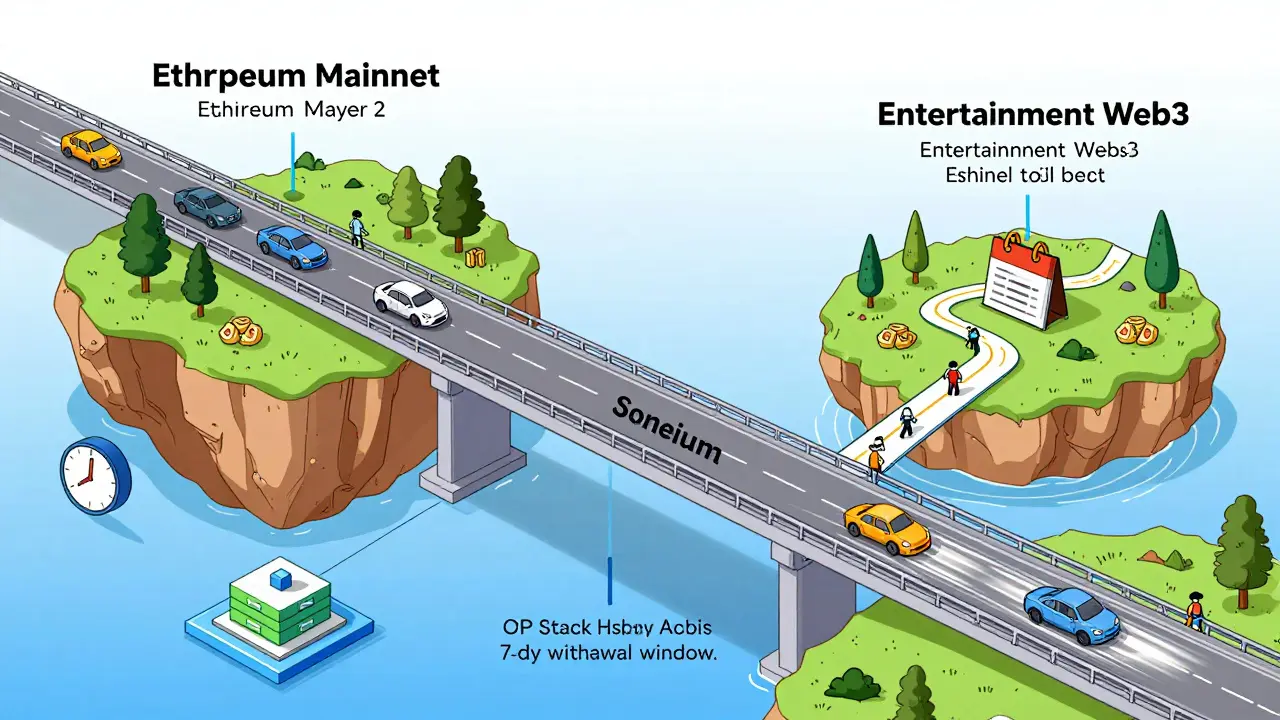
The biggest friction point for new users is the bridging process. Soneium uses the standard Optimism bridge model. Deposits are fast, but withdrawals back to Ethereum mainnet involve a 7-day challenge window. This is a security feature inherent to fraud-proof mechanisms, not a bug in Uniswap. If you need your funds urgently, this delay can be a dealbreaker.
| Feature | Uniswap v3 (Soneium) | Uniswap v3 (Ethereum Mainnet) |
|---|---|---|
| Average Gas Fee | $0.03 - $0.10 | $5.00 - $50.00+ |
| Withdrawal Time to ETH | 7 days (bridge challenge) | Instant (on-chain) |
| Total Liquidity (Approx.) | $12.7 million | $4+ billion |
| Active Pools | 87+ | 5,300+ |
| Primary Use Case | Entertainment NFTs, Fan Tokens | General DeFi, Large Swaps |
Liquidity and Trading Realities
Let’s talk numbers. While Uniswap dominates the global DEX space, Soneium-specific liquidity is still growing. As of late 2024, total value locked (TVL) in Uniswap pools on Soneium hovered around $12.7 million. Compare that to Ethereum mainnet, and you see a stark difference. This matters because lower liquidity means higher slippage when trading large amounts.
During high-demand events, such as the Sandalphone concert NFT drop, slippage hit 3.2% during peak traffic. For small trades-say, buying $100 worth of fan tokens-this is manageable. But if you are trying to move $10,000 in a single transaction, you might get worse prices than expected. The solution? Break large orders into smaller chunks or use limit orders if the interface allows.
For liquidity providers (LPs), the opportunity is different. Concentrated liquidity shines here. Since entertainment tokens can be volatile, setting narrow price ranges (15-20% bands) around the current price can maximize fee earnings. However, impermanent loss is a real risk. If a token pumps hard after you provide liquidity, you end up selling your tokens too early. Only provide liquidity if you believe in the long-term value of the asset pair.
Who Should Use This Platform?
Not every trader needs Uniswap on Soneium. In fact, for many, it adds unnecessary complexity. Here is who benefits most:
- Entertainment Fans: If you are participating in Sony-backed initiatives like Solo Leveling minting or J-pop group engagement, this is the native environment. The seamless connection between IP and finance is unmatched.
- Small-Batch Traders: Those moving small amounts of capital ($10-$500) benefit from near-zero gas fees. On Ethereum, these costs would eat your profits.
- Liquidity Providers Seeking Niche Markets: If you want to earn fees from emerging entertainment tokens before they hit major centralized exchanges, Soneium offers early access.
Who should avoid it? High-frequency traders needing instant liquidity depth, or anyone who cannot wait seven days to withdraw funds to Ethereum. If you are trading millions in stablecoins, stick to Arbitrum or Ethereum mainnet where liquidity is deeper and bridges are faster.
Security and Risks
Security is paramount in DeFi. Uniswap v3 itself is battle-tested, having processed over $1 trillion in lifetime volume. However, the Soneium deployment introduces new variables. The smart contracts were deployed via an optimistic approval period, with ownership transferred to the Uniswap DAO. This is standard procedure, but the rapid timeline raised eyebrows among some security researchers.
Elena Rodriguez, a security researcher, noted concerns about the audit timeline, which was completed only 14 days post-deployment. While no exploits have occurred since launch, always assume smart contract risk exists. Never invest more than you can afford to lose, and verify contract addresses directly from official Uniswap channels.
Additionally, regulatory uncertainty looms. Japan’s Financial Services Agency (FSA) issued guidance in August 2024 suggesting that certain entertainment NFTs without financial utility may not be classified as securities. This is a positive sign for Soneium, but regulations evolve quickly. Keep an eye on local laws regarding tokenized assets.
Future Outlook: Where Is This Going?
The roadmap for Uniswap on Soneium is ambitious. Planned updates include "Soneium Swap Aggregation" to optimize cross-bridge swaps and potential integration with PlayStation Network for in-game token swaps by late 2025. If Sony successfully onboards even a fraction of its 50 million projected users, Uniswap could become the default gateway for entertainment-based DeFi.
Analysts at Delphi Digital forecast quarterly volumes of $2.4 billion by Q4 2025. Whether this happens depends on mainstream adoption. If fans start treating token swaps as casually as buying merch, Soneium wins. If they struggle with wallets and bridges, it fades into obscurity.
Is Uniswap v3 on Soneium safe to use?
Yes, the core Uniswap v3 protocol is highly secure and audited. However, the Soneium bridge involves a 7-day withdrawal period for security reasons. Always verify contract addresses and be aware that smart contract risks exist in any DeFi platform.
Why does withdrawing money take 7 days?
Soneium uses the Optimism Stack, which employs a fraud-proof mechanism. Withdrawals to Ethereum mainnet must pass through a 7-day challenge window to ensure no fraudulent transactions are finalized. This is a standard security feature for Optimism-based Layer 2s.
Can I trade Bitcoin on Uniswap Soneium?
You can trade Wrapped Bitcoin (WBTC), which is an ERC-20 representation of Bitcoin on Ethereum. Native Bitcoin (BTC) cannot be traded directly as Soneium only supports ERC-20 compatible tokens.
How do I add Soneium to my MetaMask wallet?
Go to Network Settings in MetaMask, click "Add Network," and enter the following details: Network Name: Soneium, RPC URL: https://rpc.soneium.org, Chain ID: 1946, Currency Symbol: SON, Block Explorer: https://explorer.soneium.org.
Are transaction fees really that low?
Yes. Most swaps cost between $0.03 and $0.10 in gas fees. This makes it ideal for micro-transactions and frequent trading of smaller amounts, unlike Ethereum mainnet where fees can exceed $50.


People Comments
Another Japanese corporation trying to colonize the blockchain space with their entertainment IP. It is always fascinating how Sony thinks they can just buy their way into Web3 dominance by slapping anime characters on tokens. The liquidity is pathetic, $12 million? That is a rounding error in the real DeFi world. People need to stop falling for this marketing hype and look at the actual numbers before bridging their funds into a walled garden.
oh wow, another 'revolutionary' dex that is just uniswap v3 re-skinned for otaku culture 🙄 like seriously, who needs to swap tokens for concert tickets when you can just buy them normally without dealing with gas fees and bridge delays? the whole premise feels like a solution looking for a problem. also, 7 days to withdraw?? thats not security, thats hostage taking. typical corporate greed disguised as innovation.
It is interesting to see how Sony is leveraging its existing IP portfolio to drive adoption on Soneium. While the liquidity is currently low compared to Ethereum mainnet, the strategic focus on entertainment creates a unique niche. For fans of anime or music, having a dedicated chain reduces friction in accessing digital collectibles. However, the reliance on the Optimism stack means users must be comfortable with the canonical withdrawal period. It is a trade-off between speed of entry and security of exit.
The audit timeline was only 14 days post-deployment. This is a massive red flag that most casual users will ignore. Sony Block Solutions Labs is rushing this out to meet some arbitrary quarterly target while ignoring fundamental security protocols. I suspect there are backdoors in the smart contracts that allow them to freeze assets if regulations change. Do not trust a corporation that treats your private keys as an afterthought. The 7-day withdrawal window is likely a cover for them to monitor and potentially censor transactions before they hit L1.
I have been testing the concentrated liquidity features on Soneium and the capital efficiency is genuinely impressive for small cap pairs. If you are providing liquidity for fan tokens, setting narrow ranges around the current price yields significantly higher fees than standard AMMs. Just be careful with impermanent loss during hype cycles. When a new season of an anime drops, the volatility can wipe out your position if you do not rebalance frequently. It is a high-risk, high-reward environment for LPs.
This could actually be huge for the community! Imagine being able to instantly trade merch tokens right after a concert ends. The emotional connection to the IP makes the financial aspect feel less cold and more engaging. I am excited to see how PlayStation Network integration might work in late 2025. If we can swap in-game items directly through Uniswap, it changes everything for gamers. Let us embrace this new era of fandom finance!
Everyone here is acting like this is some groundbreaking innovation. It is literally just Uniswap v3 deployed on a different chain. There is nothing special about it. The 'entertainment focus' is just marketing fluff to attract retail investors who do not understand what a DEX actually does. You are still swapping ERC-20 tokens. The only difference is you are paying slightly less in gas but losing access to deep liquidity. It is a trap for people who think they are getting something exclusive.
Let us look at the technical specifications objectively. The OP Stack implementation ensures that gas fees remain negligible, which is a significant advantage for micro-transactions. However, the 7-day challenge period for withdrawals is a structural limitation of optimistic rollups, not a bug specific to Soneium. Users must plan their capital allocation accordingly. If you require immediate liquidity, this platform is unsuitable. For long-term holders of entertainment assets, however, the cost savings are substantial.
The comparison table provided in the article highlights the stark contrast in liquidity depth. With only $12.7 million in TVL, slippage will be a major issue for any trade above $1,000. Traders should expect significant price impact during peak events. It is crucial to break large orders into smaller chunks to minimize losses. Until the liquidity matures, this platform is best suited for speculative trading of small amounts rather than serious investment strategies.
lol imagine thinking sonys ip matters in crypto 😂 its all going to zero eventually. the whole 'entertainment web3' narrative is just a way to pump dump tokens on unsuspecting fans. i see the same pattern every time a big corp tries to enter defi. they create hype, onboard retail, and then rug pull via regulatory pressure. stay away from this garbage unless you want to lose your life savings.
The philosophical implication of tokenizing fandom is profound. We are moving towards a society where cultural appreciation is quantified and traded on open markets. Does this enhance our connection to art, or does it commodify it further? Soneium attempts to bridge this gap by creating a dedicated layer for these interactions. Whether this leads to a more engaged community or merely a more transactional one remains to be seen. The technology itself is neutral; it is the human intent that defines its value.
i think its pretty cool that they are trying to make crypto easier for normal people. adding soneium to metamask is straightforward enough. just need to remember the chain id 1946. hope more anime projects join soon so there is more stuff to trade. seems like a fun experiment even if the liquidity is low right now.
I am skeptical about the 'seamless' experience mentioned. Bridging assets is never seamless. It involves multiple steps, waiting periods, and potential risks. The article glosses over the complexity of managing wallets across different chains. For the average user who just wants to buy a ticket, this adds unnecessary friction. It is not until the UX becomes invisible that mainstream adoption will truly happen.
typical american ignorance. you guys dont understand the global market dynamics. soneium is positioned perfectly for the asian market where anime and gaming are huge. you are focusing on liquidity numbers that will grow exponentially once the asia pacific region adopts it. keep crying about low tvl while we build the future of entertainment finance. your perspective is limited by your local biases.
You need to understand that regulatory clarity is key here. Japan's FSA guidance is a positive indicator, but it is not a guarantee. Entertainment NFTs without financial utility may not be securities, but the line is blurry. Investors should proceed with caution and consult legal experts. Do not assume that because Sony is involved, the project is immune to regulatory crackdowns. Compliance is an ongoing process, not a one-time event.
I appreciate the detailed breakdown of fee tiers. The 0.05% tier for stablecoins is particularly useful for arbitrageurs. However, I would encourage new users to start with very small amounts to familiarize themselves with the interface. The learning curve for decentralized exchanges can be steep. Take your time, read the documentation, and ensure you understand the risks before committing significant capital. Your financial safety is paramount.
So basically, you lock your money up for a week to save pennies on gas? That sounds like a terrible deal to me. I have better things to do than wait seven days to get my ETH back. The whole concept of 'entertainment-focused' chain feels like a gimmick. Why do I need a special chain to buy a digital sticker? Just give me fast transactions and low fees on a chain that already has deep liquidity. This feels like solving a problem that does not exist.
It is imperative that we scrutinize the governance structure of this deployment. Who controls the upgradeability proxies? If Sony retains any administrative keys, the decentralization claim is void. Users must demand full transparency regarding contract ownership. The rapid audit timeline suggests a lack of due diligence. We cannot allow corporate entities to dictate the terms of our financial sovereignty under the guise of innovation. Vigilance is required.