
EU Crypto AML Requirements: What Crypto Companies Must Do
Learn the EU's crypto AML rules, how MiCA licensing, Travel Rule and upcoming 2027 regulation affect crypto businesses, plus a practical compliance checklist.
When dealing with EU crypto AML requirements, the set of anti‑money‑laundering rules that the European Union forces crypto businesses to follow. Also known as EU crypto AML, they dictate how platforms verify users, monitor transactions, and report suspicious activity.
These rules don’t exist in a vacuum. MiCA, the Markets in Crypto‑Assets Regulation, provides the legal backdrop for EU crypto AML requirements and forces firms to embed compliance into product design. The travel rule, an international standard that obliges crypto services to share sender and receiver information on transfers above a certain threshold is another piece of the puzzle, feeding data directly into EU monitoring systems. Meanwhile, FinCEN, the U.S. Financial Crimes Enforcement Network, sets global expectations that influence EU AML frameworks through cross‑border coordination.
Understanding EU crypto AML requirements saves you from costly fines and account freezes. The core attributes of the regime include mandatory KYC, Know‑Your‑Customer checks that collect identity documents before anyone can trade and continuous transaction monitoring, real‑time analysis that flags patterns typical of money laundering or terrorist financing. If you run a crypto exchange, you’ll need to integrate AML software, train staff, and keep audit trails for at least five years. For individual traders, the impact is lighter but still concrete: you’ll see more ID prompts, occasional verification emails, and stricter limits on anonymous withdrawals.
The EU’s approach also creates a competitive edge. By standardising compliance across member states, MiCA and the AML framework reduce uncertainty for businesses that want to expand across Europe. This uniformity means a single compliance program can unlock access to 27 markets, and the travel rule’s data‑sharing requirement helps authorities spot cross‑border illicit flows faster. In practice, you’ll notice tighter integration between exchanges, wallets, and regulated financial institutions—all aimed at making crypto safer.
One practical tip: keep a digital copy of all your identity documents and transaction records in a secure folder. When a regulator asks for proof, you’ll have everything ready, and you won’t scramble for files under pressure. Also, stay updated on any amendments to MiCA or the EU’s Fifth Anti‑Money‑Laundering Directive, because the rules evolve as new risks emerge, such as decentralized finance protocols and NFT marketplaces.
Below you’ll find a curated list of articles that dive deeper into each of these topics—from how the travel rule works in practice to step‑by‑step guides for implementing KYC on a crypto platform. Whether you’re a trader, an exchange operator, or just curious about the regulatory landscape, the posts ahead will give you actionable insights and real‑world examples to stay compliant and confident in the EU market.
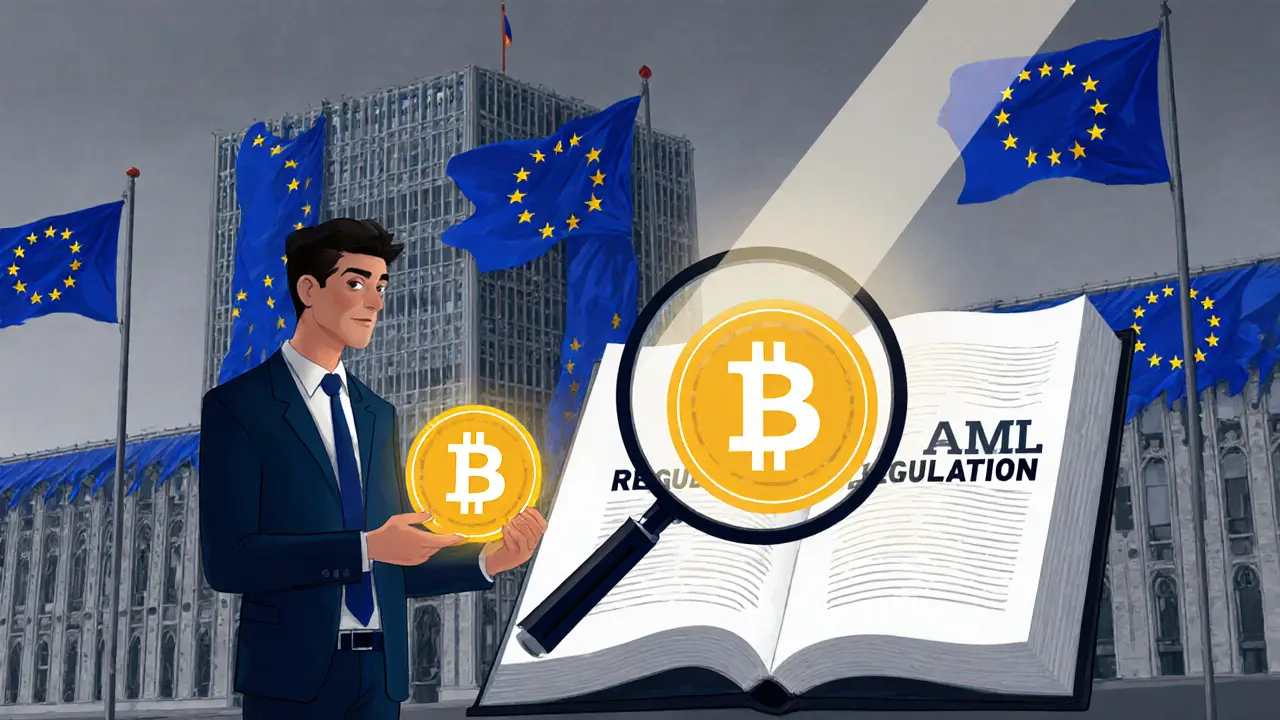
Learn the EU's crypto AML rules, how MiCA licensing, Travel Rule and upcoming 2027 regulation affect crypto businesses, plus a practical compliance checklist.